
Closed Cooling Tower for Data Center Cooling
Date:2026-10-29As data centers expand to support cloud computing, AI workloads, and high-density servers, heat rejection has become a critical consideration in cooling system design. Maintaining stable operating temperatures is essential, but the effectiveness of a cooling solution also depends on fluid quality, water management, maintenance requirements, and the operating conditions of the facility.
SHENGLIN's closed cooling tower solutions provide an alternative for data center projects that require reliable heat rejection and a controlled process fluid circuit. Rather than exposing the process fluid directly to the external environment, a closed-circuit cooling tower uses indirect heat transfer to support stable cooling system operation.
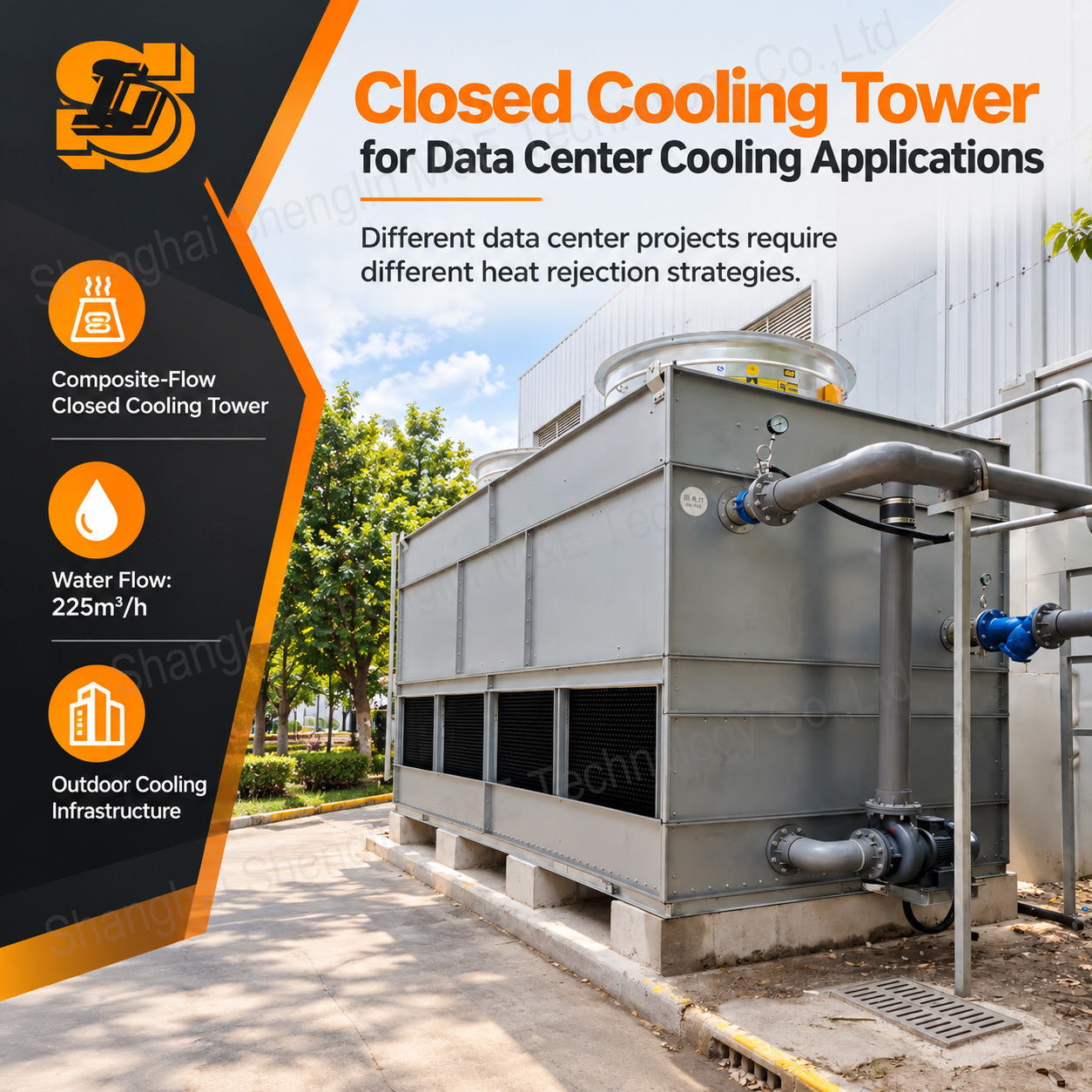
How Does a Closed Cooling Tower Work?
A closed cooling tower combines a heat exchanger with evaporative cooling. The process fluid circulates inside a coil, while spray water flows over the coil's external surface. Air passes through the unit, allowing heat to transfer from the process fluid to the surrounding air through the heat exchanger and spray-water circuit.
This arrangement keeps the primary process fluid separate from the external spray water and ambient air. For data center applications, this separation can help reduce contamination risks and simplify fluid quality management in the protected circuit.
The actual cooling performance depends on the equipment configuration, entering fluid temperature, ambient wet-bulb temperature, airflow, and system load. These factors should be evaluated during the engineering and equipment selection stages.
Why Consider Closed Cooling Towers for Data Centers?
1. Protect the Quality of the Process Fluid
Data center cooling systems may include heat exchangers, chillers, and liquid cooling distribution equipment that depend on controlled fluid conditions. A closed-circuit cooling tower helps isolate the primary fluid from direct contact with the external environment, reducing the potential for contamination and deposits within the coil circuit.
This arrangement can be particularly valuable when fluid quality is an important consideration for connected equipment.
2. Support Reliable Heat Rejection
IT equipment generates heat continuously, and cooling infrastructure must respond to changes in server utilization and outdoor conditions. Closed cooling towers provide an external heat rejection option that can be integrated into a properly designed cooling water system.
For high-density computing facilities, the tower should be selected according to the required heat rejection capacity, design temperatures, and operating conditions. Appropriate system controls and maintenance procedures are also essential to support reliable performance.
3. Improve Flexibility in Cooling System Design
Different data centers have different cooling requirements. Conventional server rooms, high-density computing facilities, and liquid-cooled AI infrastructure may operate with different fluid temperatures and heat rejection arrangements.
A closed cooling tower can be considered as part of a water-cooled or hybrid cooling architecture. Depending on the design, it may operate alongside chillers, heat exchangers, or liquid cooling systems. The final configuration should reflect the facility's thermal load, local climate, water availability, and energy objectives.
4. Simplify Fluid Management and Maintenance Planning
Because the primary fluid circulates through a closed coil, it is less directly exposed to airborne contaminants and external water quality variations. This can help reduce maintenance concerns associated with contamination inside the protected circuit.
However, closed cooling towers still require appropriate spray-water treatment, basin cleaning, scale control, and inspection of heat transfer surfaces. A well-planned maintenance strategy remains important for long-term operation.
What Should Engineers Evaluate Before Selection?
Choosing a closed cooling tower requires more than comparing nominal cooling capacities. Data center designers should consider several interconnected factors:
1.Heat rejection load: Calculate the total thermal load under the intended operating conditions.
2.Design temperatures: Confirm the required fluid inlet and outlet temperatures and the local outdoor design conditions.
3.Water management: Evaluate water availability, treatment requirements, and expected consumption.
4.System integration: Verify compatibility with chillers, heat exchangers, pumps, and the facility's cooling control strategy.
5.Space and maintenance access: Allow sufficient room for installation, airflow, inspection, and servicing.
6.Operating efficiency: Assess fan and pump power alongside the performance of the complete cooling system.
A properly selected tower should match the facility's actual operating profile rather than relying on a single rated-capacity figure.
SHENGLIN: Cooling Infrastructure for Evolving Data Center Needs
SHENGLIN provides cooling equipment and integrated thermal management solutions for industrial and data center applications. Closed cooling towers can serve as an important component of an appropriately engineered heat rejection system, helping project teams balance process fluid protection, operational reliability, and site-specific requirements.
As computing density continues to increase, effective heat rejection depends on selecting the right equipment and coordinating it with the wider cooling infrastructure. SHENGLIN supports customers in evaluating application requirements and developing cooling solutions aligned with their project conditions and long-term operational goals.


- 01 Feb,2024Dry Cooler D4-8x910 In Stock Is On Sale! Discount!
- 06 Sep,2023Pad Adiabatic Dry Cooler Trial Operation Before Shipment
- 06 Sep,2023828kW Adiabatic Cooling System Dry Cooler Loading
- 17 Aug,2022Flat Type Dry Cooler Finished For Canada Client
- 06 Sep,20231061kW dry cooler loading for USA client
- 31 Mar,2021Peru client Install Shenglin Adiabatic Dry Cooler At Site